Educators try to come to terms with low math scores on Smarter Balanced tests
 Credit: Lillian Mongeau for EdSource
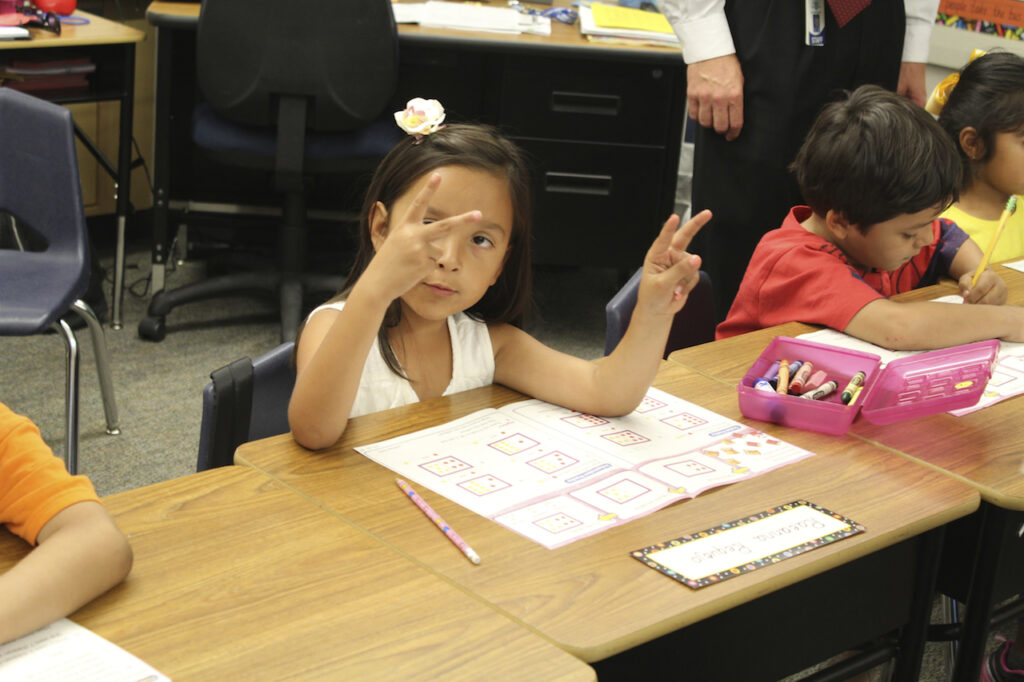
A girl adds on her fingers to consummate a 1st grade math problem in Fresno.
 Credit: Lillian Mongeau for EdSource
A girl adds on her fingers to consummate a 1st grade math problem in Fresno.
Equally parents across the country open the envelopes containing their children's scores on the new Smarter Balanced assessments administered last spring, just a third of them will encounter that their children met or exceeded the math standard on the new Common Core-aligned tests.
In fact, only one-3rd of California students in grades 3-eight and class 11 met the math standard – compared to 44 percentage of students who met the standard in English language arts. That is also significantly lower than the percentage who scored at a proficient level in math on the sometime California Standards tests.
Although math is a stumbling block for many, mastering it is essential for students if they wish to accelerate in both college and the workplace. Students are required to pass Algebra I to graduate from high schoolhouse, and pass Algebra II in club to enroll at most iv-year universities, including UC and CSU.
Once in higher, students are mostly required to complete an advanced math course beyond Algebra Two to earn a four-yr degree. In addition, a deeper understanding of math is required for many other courses both in high school and college, such equally physics, chemical science, engineering and computer programming.
But rather than react with alarm, educators are urging both students and parents to non go discouraged by the initial Smarter Balanced math results, a fundamental role of what the state calls the California Assessment of Student Progress and Performance, or CAASPP. "If students take been doing well in math and now go poor results, yous don't desire parents to think kids are bad in math or kids to become discouraged," said Phil Daro, who was one of the principal writers to draw up the Common Core math standards. "That is the single biggest danger in the shift (to Mutual Core), peculiarly in math where it is piece of cake to ruin a kid'south disposition to math."
"We knew that with new standards and new tests, results would be challenging for schools," said Jose Dorado, coordinator for elementary mathematics for Los Angeles Unified. "Nosotros're raising the bar significantly. When you change the way you examination kids, yous might non immediately get the results you desire."
Educators overseeing math education betoken to a range of challenges they face in gild to improve math results. These include concerns that computer-based testing doesn't provide the best platform for students to utilise their noesis in math, inconsistent implementation of the Common Core math standards from one commune to another, and lack of training and support for math teachers who are implementing the new standards for the first fourth dimension.
Vicki Vierra, president of the California Mathematics Council, a professional network of more 6,000 math teachers from districts across the state, said she doesn't necessarily see the test results as troubling, merely rather a result of raising expectations for children. "Information technology'south important to recall that the math has not changed," she said. "What has changed is that nosotros now accept this new process for students to think and explain how they're learning. These new tests are part of this transition. It's going to have some fourth dimension."
Officials overseeing math instruction in some of the state's largest districts said they are themselves trying to interpret the test results."In that location is some disappointment because yous look at how hard the kids worked and how hard we all worked, and the results aren't good enough," said Phil Tucher, mathematics manager at Oakland Unified, where 23 pct of students met or exceeded the math standard. "But nosotros accept nothing to compare them to. Nosotros looked at each of our schools when these results came out, and our initial thoughts were, 'What do these scores mean?'"
He and others in his district are yet trying to sympathise how some campuses that earned among the district's highest math scores on the old California Standards Tests earned amid the everyman scores in the district on the Smarter Balanced tests. For example, only 13 percent of students at Parker Elementary met or exceeded the math standard on the Smarter Balanced tests, while 77 pct of students at Parker tested expert or advanced in math on the California Standards Tests in 2013.
"It's important to recall that the math has non inverse. What has changed is that we now take this new process for students to remember and explain how they're learning," said Vicki Vierra, president of the California Mathematics Council.
Land Superintendent Tom Torlakson said that the new scores should serve equally a "starting point." He and others say they look students' scores to amend over time, as they did under the former California Standards Tests administered for the last fourth dimension in the bound of 2013. In 2002, the starting time year the CSTs were administered, xxx percent of 8th graders scored at a proficient or avant-garde level – approximately the proportion who were deemed to have "met or exceeded" the standards on the electric current exam. Ten years later, 52 percent of eighth-form students were scoring at proficient level.
In Los Angeles Unified, where 25 percent of all students met or exceeded the standards, officials are trying to empathize what the results mean for actual classroom instruction. "With the Smarter Counterbalanced tests, at that place are a lot of moving parts," Dorado, the commune'southward unproblematic math coordinator, said. "Information technology's very circuitous."
For example, students' math scores are cleaved downwards into three categories: "problem solving and modeling/information analysis," "concepts and procedures" and "communicating reasoning." The district's initial analysis shows students had meaning success on the "communicating reasoning" section of the examination, which measures how well students provided evidence or constructed feasible arguments to explain how they solved math problems. About 61 percent of Los Angeles students met or nearly met achievement targets in "communicating reasoning," including 57 percentage of the district's low-income students. That is 6 percent points higher than the statewide average for low-income students.
Dorado credits a learning module called Math Practice 3, which all commune simple schools have used for three total years, for helping teach students how to better explicate their thinking in solving math issues. He said that Math Do 3 has been successful in teaching students to not just to come up with the right answers, but also to justify them.
It's also important for parents to recall, Dorado said, that Smarter Balanced math scores alone don't indicate how well students are learning math aligned with the Common Core. He noted that iii-quarters of Los Angeles Unified students are not failing their math classes. "As we move forward, we need to recollect nearly what other measures we are using (to estimate success in math)," he said. "Grades, teacher reports and classroom piece of work tell us more virtually this student than a single score in this one test."
Classroom math not aligned to tests
Like Los Angeles, districts across California are however working toward fully aligning classroom education with the Mutual Core, which Dorado said ways a large portion of students were tested on a curriculum they haven't been completely immersed in. "Los Angeles started implementing Common Cadre 3 years ago," Dorado said. "Information technology takes time and a tremendous corporeality of work. In LAUSD, nosotros're talking 500 uncomplicated schools alone."
Another challenge has been the shortage and quality of curriculum materials aligned with the standards. "Many teachers are in the implementation stage," said the California Mathematics Council's Vierra. "Many districts are all the same getting effectually to buying the curriculum (materials they need)."
"A lot of teachers are cobbling together one-time materials with lessons they find online and material the district is providing," she said. "Much of the math curriculum is still very fragmented."
Oakland's Tucher said information technology'southward going to take several years before the curriculum students are learning in the classroom is fully aligned with what the Smarter Counterbalanced tests are measuring. He took issue with the idea that California has been implementing the Common Core for iii years, following the curriculum'southward official adoption in 2010. "This whole notion that in California we have been doing the Common Core for three years … are you kidding?" he said. "Iii years ago we were preparing students for completely different exams."
Tucher said that even if teachers now have materials that are fully aligned with the Common Cadre, and fifty-fifty if they've received adequate training, they're still working with students who've had meaning gaps in Common Core instruction in previous years.
"It'southward a process," he said. "These initial SBAC scores reflect an early milestone to advance us on our way."
Daro believes there's withal a great disconnect betwixt what the Smarter Balanced tests measure out and what students are currently learning in the classroom – and that math teaching varies significantly from district to district. "We accept a ways to go in terms of instructional materials, teachers' noesis of math – these things change slowly," said Daro. "I accept non seen sweeping changes in the classroom."
Jim Ryan, San Francisco Unified's executive director for science, applied science, engineering and math, or Stem, said math educational activity in San Francisco classrooms is unrecognizable compared to how students learned just three years ago. Then students saturday at their desks in rows solving issues on their own. The faster they completed a problem, the more they were regarded has having mastered the topic. Ryan described this approach every bit "naked math" considering it represented a very stripped-down learning model that involved minimal interaction and collaboration among students.
Now, students work in pairs or groups, arguing about what the correct approach is to a problem, Ryan said. They have to explain their reasoning and justify it to ane another. "It's a much noisier classroom," he said.
Technology divide
Some educators and experts likewise question whether having students take the Smarter Balanced test online is the best way for them to test students. "Mathematicians practise their best work on the back of envelopes, or on some scratch paper," said LA Unified'southward Dorado. "When you inquire youngsters to graph upward some information or run some calculations, nosotros have to exist conscientious and let the testing environment to incentivize students to practice the right things."
Currently, some portions of the Smarter Counterbalanced tests allow for students to use scratch paper. But only the work done online is counted toward a student's last score. Some educators said they anticipate the tests will somewhen include technology that allows freehand drawing on computer screens to provide students with more ways to piece of work out bug.
Some other issue with computer-based testing is that the degree of reckoner literacy, or even everyday access to technology, can vary widely among students. In many urban districts with loftier rates of depression-income students, including Los Angeles and Oakland, many students but accept admission to computers at schoolhouse. Many schools still don't take enough computers, reliable WiFi networks or other engineering science in place to provide students regular digital access during daily math lessons.
Only learning to drag and drop graph points on the screen or scrolling through drop-downward boxes could testify challenging for test-takers with express reckoner experience, Dorado said. "Nosotros need more of our youngsters to be on the computer (during the year), so when the examination comes along, it's not then foreign and foreign," he said.
Los Angeles is standing to upgrade technology in the classroom, but high costs are hampering those efforts, he said.
EdSource Today editor-at-big John Fensterwald contributed to this report.
To get more reports like this 1, click here to sign up for EdSource's no-cost daily email on latest developments in education.
Source: https://edsource.org/2015/educators-try-to-come-to-terms-with-low-math-scores-on-smarter-balanced-tests/88899
0 Response to "Educators try to come to terms with low math scores on Smarter Balanced tests"
Post a Comment