Modern Art With Straigh Lines on Canvas With Fabric Colours
Oil and acrylic paintings these days are near frequently created on canvas. Sail replaced forest panels for painting during the Renaissance because stretching sheet across wooden bars immune for larger paintings that were portable, because they were lighter and could be rolled, too as existence a more than stable surface with less warping and great than a wooden panel. The first artist canvases were made from high-quality Venetian hemp sailcloth and the word canvas derives from cannabis (hemp) – canvas made from linen was introduced soon after and cotton is a more recent choice of fibre.
Whether you are stretching your own canvas or buying ready-prepared stretched canvases or canvas boards, in that location are many types of canvas fabrics to choose from. The characteristics you require of your surface will decide which you choose. The weight of the fabric, the material it is made from and the surface preparation, in unlike combinations will each requite a different painting feel and volition bear upon the final appearance of your painting.
At Jackson's we stock a good variety of canvas that should cover nearly artists' needs. You can go a huge range of sizes and surface characteristics in ready-to-pigment stretched canvases, just unwrap them and go! Or you could add a final blanket of a ground to it to customise your surface. At that place are sparse canvas panels and Ultralite boards which are great for plein air painting because they are lightweight and volition fit in almost pochade boxes. If you lot wish to stretch your own sheet we take 40 variations of sail by the metre or by the ten-metre roll.
Many artists endeavor painting on different canvases, primers and grounds until they notice the surface that works best for how they paint. The surface qualities can profoundly touch some artists' painting, fifty-fifty more than so for techniques similar staining in oils or acrylics. You lot tin can compare some of the canvases that Jackson'southward stock by ordering sample pieces of the Claessens Linen or the Claessens Linen sample book or the Belle Arti sample book.
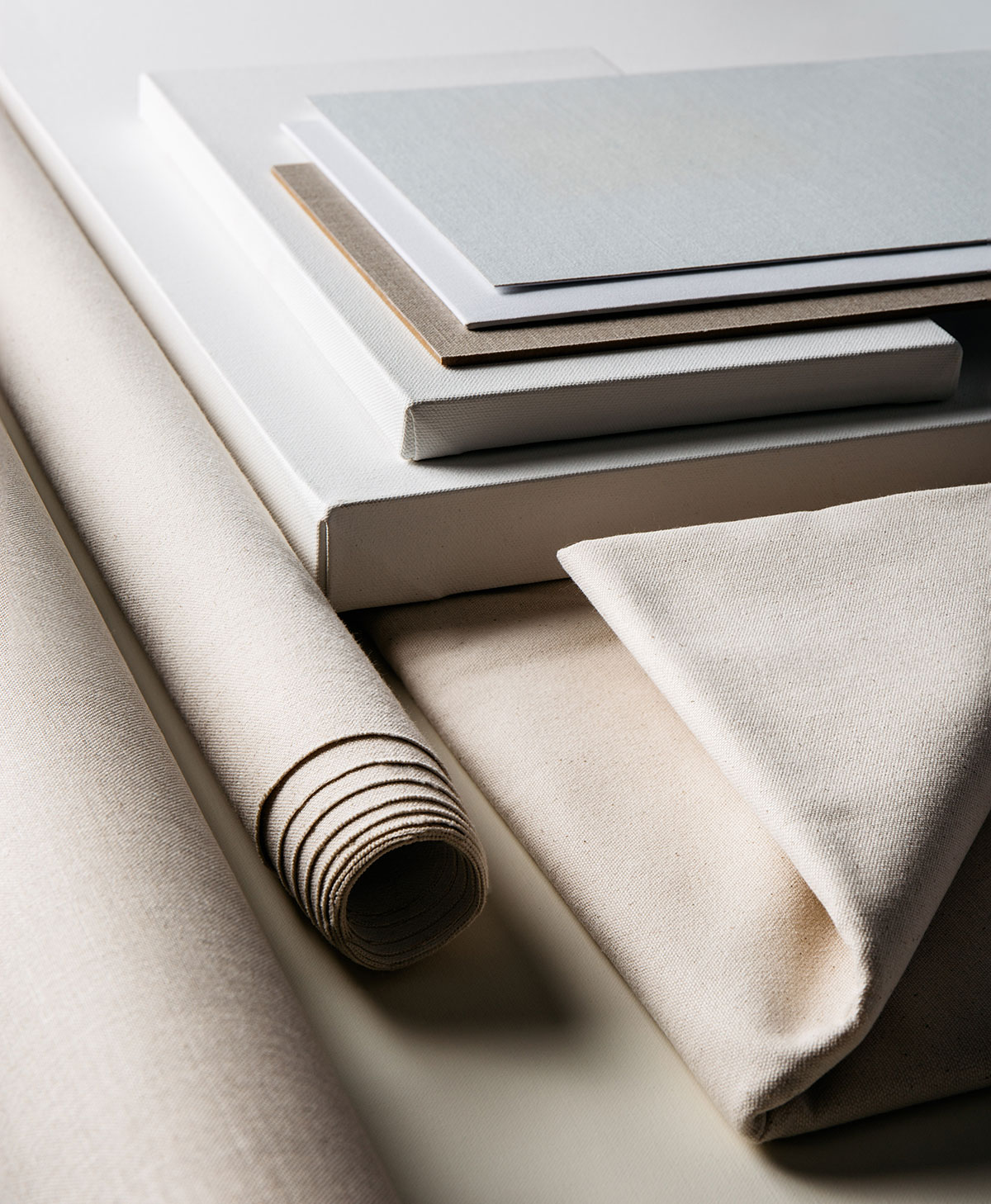
Hither are some things to consider when choosing which canvas to paint on:
(click on the images for a larger view)
Textile
There are two major fibre types used to make canvas: cotton and linen (flax). Some speciality fibres such equally hemp and jute are too used for canvas – we practise jute, and although it is a different fibre it is usually considered an actress-rough linen because it is very similar.
Cotton fiber
Cotton wool is economic but not as strong as linen and it hasn't been time-tested like the linen used past the old masters. Cotton is easy to stretch and stays tight on the stretcher bars. Linen is made from flax and is stronger because information technology has longer fibres which ways that it is less probable to tear at the staple line or at the sharp exterior corner of the stretcher bar. It besides ways that yous can use finer and thinner linen for the same forcefulness equally heavier cottons. The stiffness of linen means information technology is harder to pull when stretching and yous need to accept intendance to keep even tension across the canvass or information technology can ripple along the edges subsequently. Some artists choose to buy ready-prepared linen canvases considering linen has a reputation for being much more than difficult to stretch than cotton fiber. Unprimed cotton is usually a foam colour and unprimed linen is normally a brown because information technology is unbleached, but we take some primed Italian cotton that has a coating on the reverse that makes it darker on the back. Cotton Duck Canvas has more tightly woven threads than plain cotton sail – the term 'duck' comes from the Dutch give-and-take for cloth, doek.
We stock two types of cotton by the metre: Cotton Duck is the nearly common sheet in the globe, it has many uses outside of art (canvas bags and so on), it commonly has a noticeable weave and is quite thick. Nosotros stock it in three weights. Because of its low price information technology is our nigh popular canvas sold by the metre (and the gyre) and for our bespoke canvases – the 12oz primed, to exist exact. Our Italian Poly-cotton is an artist's canvas, information technology is made for our manufacture so it has a tighter weave, a finer thread and an overall smoother surface, even the 'medium' texture Italian cotton fiber is finer than the cotton duck nosotros stock. In that location is also a super fine texture chosen No-Grain. The improver of polyester ways the fabric will not 'relax' every bit much as all cotton and get loose over time.

Cotton canvas
From the left:
Jackson'due south 8 oz, 10 oz (primed & unprimed), and 12 oz (primed & unprimed).
And then Belle Arti 586. 575, 564, 576.
- Cotton wool Canvas Boards
- Cotton wool Stretched Canvases
- Cotton wool Canvas by the metre
- All formats of cotton canvas at Jackson'due south
Linen
Linen is more expensive than cotton fiber, partly because cotton canvas is much more than common and in that location are many non-fine art uses for information technology, so the lower toll is a result of the marketplace. There is professional quality creative person cotton fiber sail as well which is more expensive because information technology has a much smaller market demand. Linen is also more plush than cotton because information technology takes many more steps to process the flax fibres and because its inelasticity makes it harder to weave into fabric.
At Jackson's we stock linen by the metre from three manufacturers. The French linen canvas from Artfix is made of smoother, more than tightly spun yarn than the Italian linen from Belle Arti, and as well has a more than regular, tighter weave and is really stiff. The Belgian linen from Claessens is between the two. Because the famous Artfix company uses the highest grade of flax and has amazing quality command it is a superb linen. If you lot paint, scrape, repaint, scratch back, repaint, impasto, scumble glaze, and generally are hard on your surfaces and so the French linen is a slap-up choice every bit information technology will survive the rough handling. Because it is and so tight it can be a job to stretch information technology, though and it is our highest priced canvas likewise. Claessens is located in the eye of the Flax Commune in Belgium. Their linen is made using minor calibration production and longstanding traditional sizing and priming methods. They utilize the primers by hand with a palette pocketknife. The Italian is fabricated with a bit coarser thread and more than irregular weave but is a very good quality and nosotros are lucky to have gotten such a good price on it, it is lower priced than information technology should be for the quality. It is also easier to stretch than the French linen. Nosotros likewise stock jute for a fibroid 3D texture and at a depression price for its thickness.
In addition to the not bad strength of linen and the fantastic surface it gives for painting, linen has enshroud among art collectors and then artists will ordinarily mention in their materials list -that information technology was specifically linen they painted on. Also there is something romantic about painting in oils made with linseed oil on a linen sheet – both being made from the flax establish.
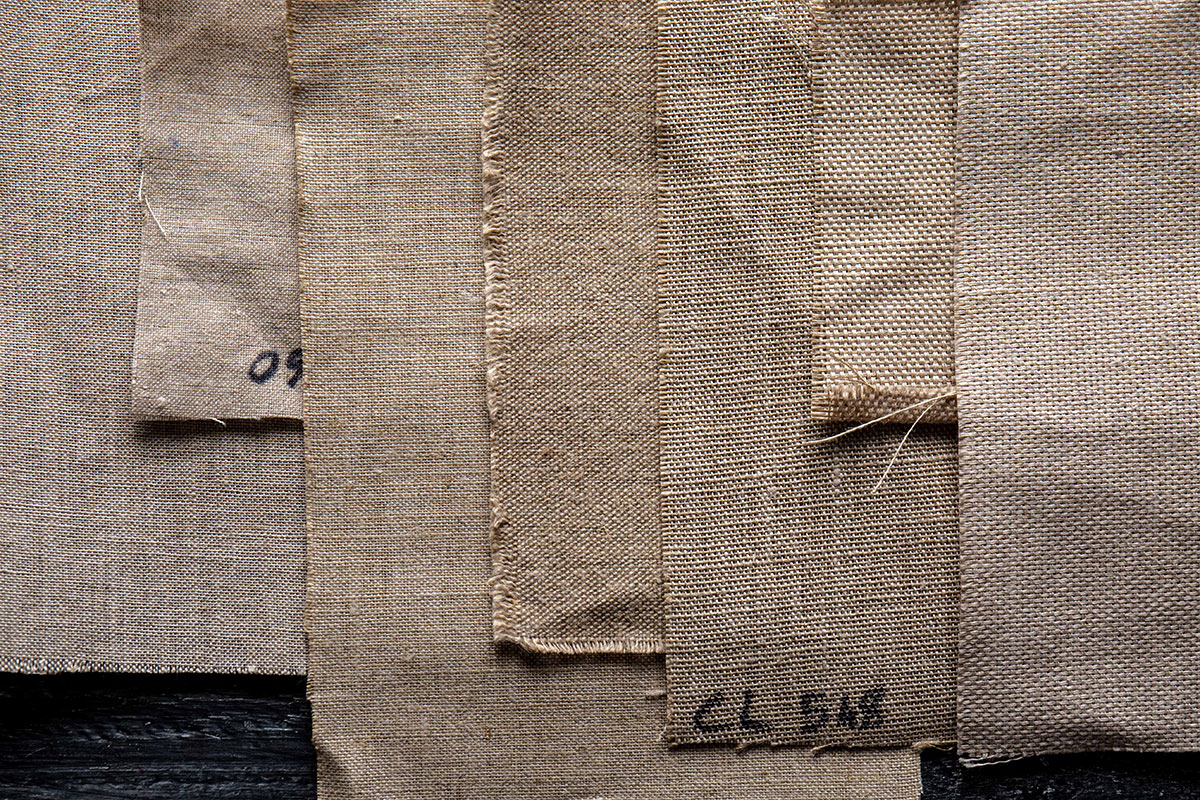
Unprimed linens
From left – finest to roughest: 549, 60, 596, 40, 548, 90, 581.
- Linen Canvas Boards
- Linen Stretched Canvases
- Linen Canvas by the metre
- All formats of linen canvass at Jackson's
Weave
In addition to choosing the fibre type y'all also demand to consider the weight and the texture of the weave. Similarly to paper, canvas is measured in grams per square meter (gsm) or ounces per foursquare yard (oz). If the linen has a heavy weight then i or both of the following is true: information technology is a thick, tough yarn and/or information technology is tightly woven. Lightweight linens have an open weave and generally a fine yarn, they are easier to stretch and are more than responsive to tightening procedures. The lighter weight canvases are usually used by artists who draw and/or have a light touch in their work, but fifty-fifty some impasto painters can use them as their paint skims over the air holes.
A fine canvass has minimal texture and tin can be well-nigh smooth, while a rough canvas has a very pronounced weave. The selection of no grain, extra-fine, fine, medium, rough and extra-crude texture in a canvas affects the feel of painting and the final appearance. Do yous want to see the grid-like weave, to take your brush skip over the bumps to leave bits of white to sparkle, or to build up layers of pigment on the weave high points; or practise you desire a surface where the sail is not a noticeable feature? Practice you desire a texture that thick paint can take hold of onto or a smoother, slicker surface for thin paint to glide over? A smooth texture is oftentimes important to portrait painters as a coarser texture can misconstrue the appearance of skin, then extra-fine linen canvass is sometimes even chosen Portrait Linen. The 'No Grain' texture is virtually as smoothen every bit paper and is also nifty for portraits.
The terms 'super fine', 'extra fine', 'fine', 'medium' and 'rough' refer to the texture of the weave not the weight. Texture is non necessarily a guide to the weight. You can have a lightweight canvas with a rough or medium texture or a heavier weight sail with an extra-fine texture. Our 574 Italian universal primed linen is both lightweight and and then fine that it feels similar a sheet of newspaper, but considering it is linen it is strong plenty to stretch tightly. Some artists particularly honey the 574 canvas considering it can have watercolour and inks. Our 568 universal primed Italian linen is strong and heavy enough for big scale work, has plenty give to be able to stretch nicely, has a tight weave and so tin be used for both glazing and impasto piece of work and anybody says it is just plain beautiful.
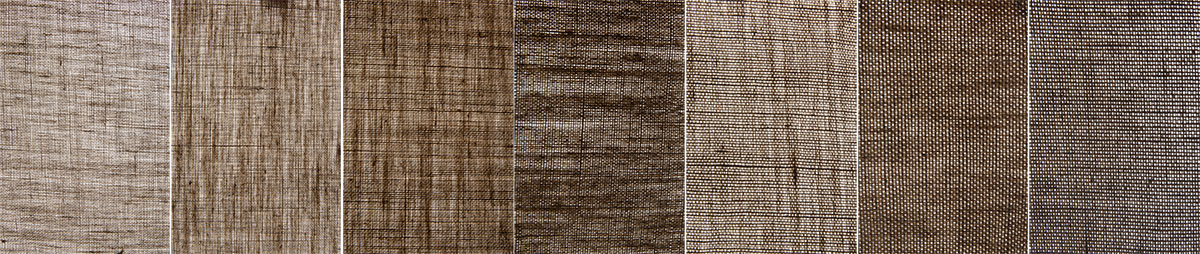
7 linen canvases with light behind to show the weave.
From left – finest to roughest: 549, lx, 596, 40, 548, ninety, 581.
- Extra fine sail in all formats
- Fine canvas in all formats
- Medium canvas in all formats
- Rough canvas in all formats
Weight
The heavier the weight the more tension the sheet fabric tin accept without fierce, and so for very large stretched canvases you lot might wish to choose a heavier sail. Weight is how much textile there is per surface area so it is determined by both thickness of the thread used to weave and how tightly it is woven. A coarse/crude canvass can be loosely woven and so information technology could be lighter weight than a fine sail that is tightly woven. Only usually, a thick thread makes a heavy canvas and a sparse thread makes a light canvas.
Unprimed sail can be considered light-weight at virtually five oz (140 thousand); medium-weight at about viii oz (230 g); heavy-weight at nigh ten oz (280 g) or more. When the canvas is primed the weight listed includes primer and then information technology tin can be hard to compare the weight of the actual canvass as some accept a much thicker layer of primer than others. When we have the information, we listing the canvas weight on the Jackson's website both earlier and after priming.
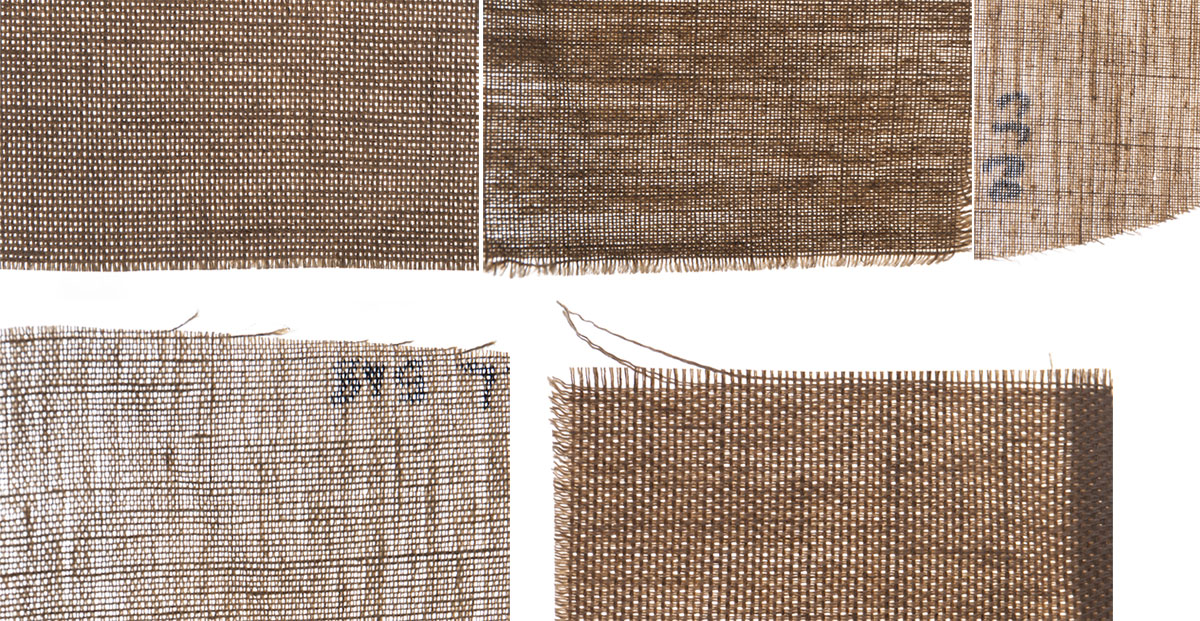
Shown is a variety of linen weaves – the looser ones fray more at the edge – these would be more lightweight than tightly woven sheet using the same size thread.
- Light-weight canvas by the metre
- Medium-weight canvas past the metre
- Heavy-weight canvass by the metre
Brand
Jackson's stocks 4 brands of creative person canvass bachelor by the metre: Artfix (French linen), Claessens (Belgian linen), Belle Arti (Italian linen and cotton fiber), Jackson's (Indian cotton fiber). These highest quality canvases are besides used for our Bespoke stretched canvases, our professional-course ready-made stretched canvases and our Handmade Linen Boards.
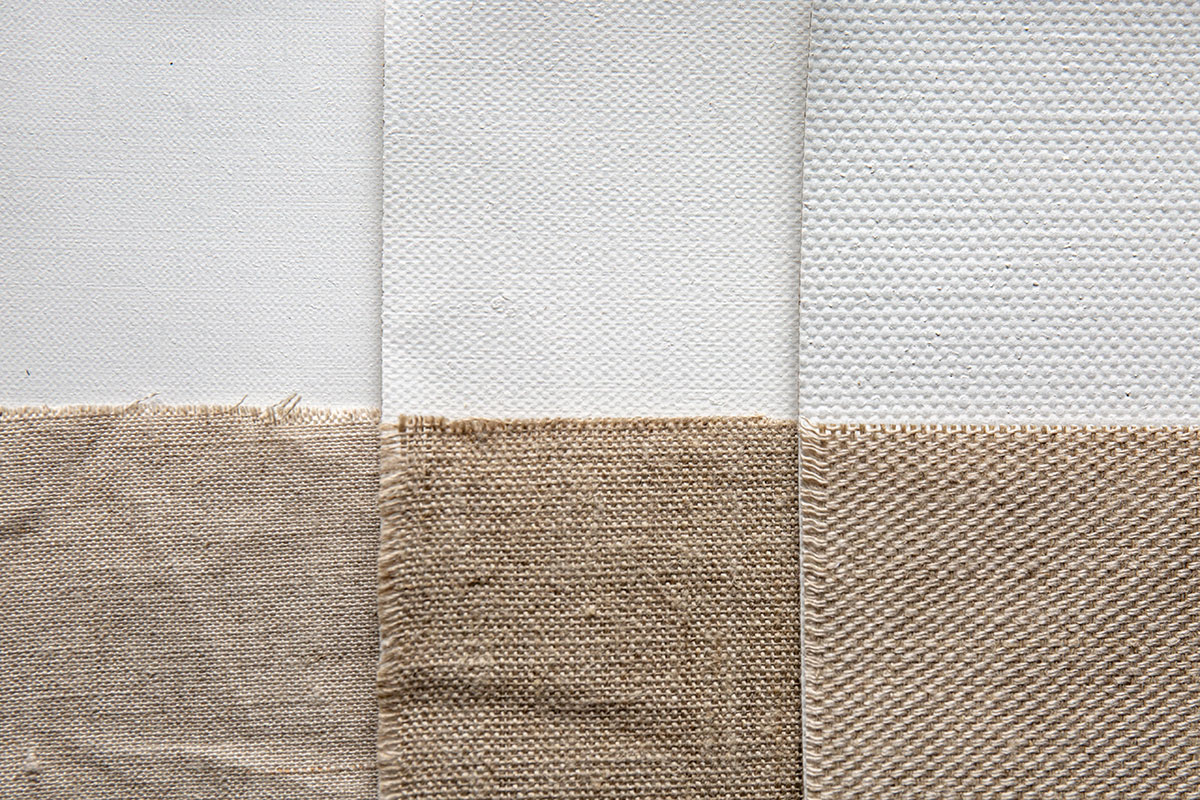
half dozen Artfix Linens – primed and unprimed.
From the left: Extra fine, fine and medium.
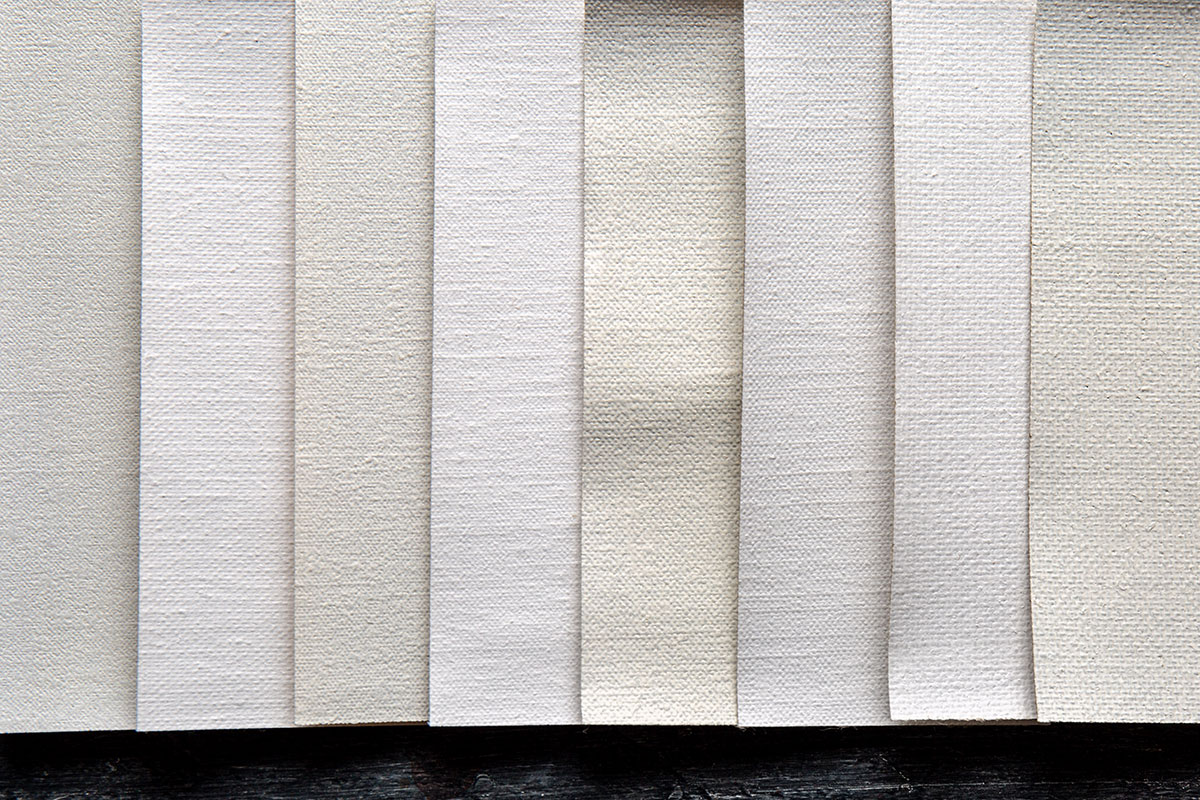
8 Claessens linens
From the left from Very Fine to Heavy.
From the left thirteen, 109, 706, 112, 66, 166, 170, 70.
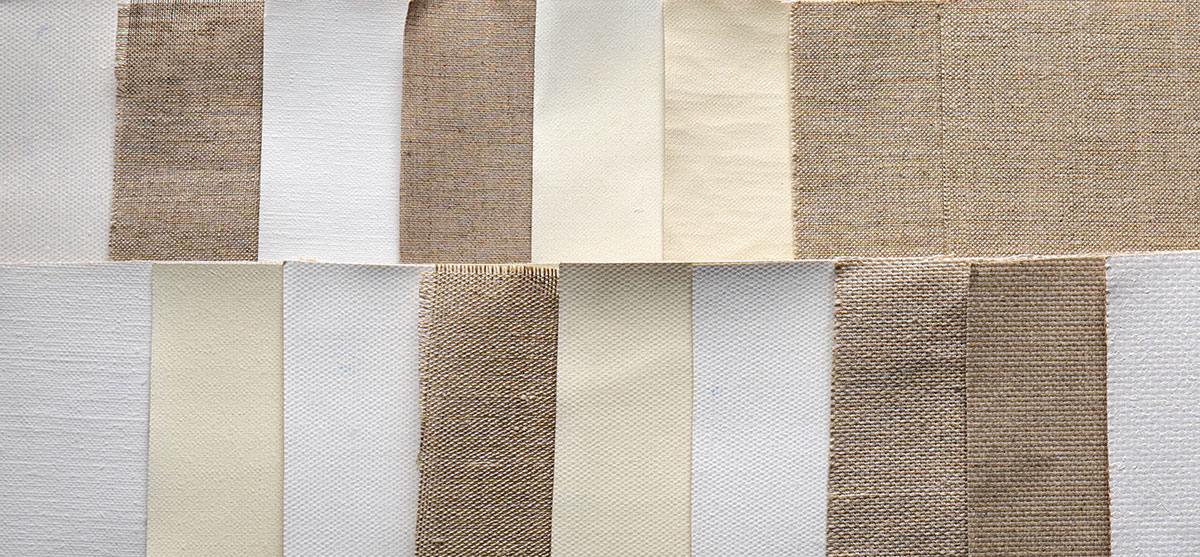
17 Belle Arti linen canvases from Finest to Jute.
From the left – tiptop row: 511, 549, 574, 649, 540, 007, 596, 696.
From the left – bottom row: 535, 537, 533, 548, 536, 568, 581, 681, 565.

Jackson's Indian Cotton wool canvas.
From the left 8 oz primed, 10 oz (primed and unprimed), 12 oz (primed and unprimed).
We likewise do a wide selection of ready-made stretched canvases and boards that apply other artist-form and student-course canvas.
Rolls of canvas
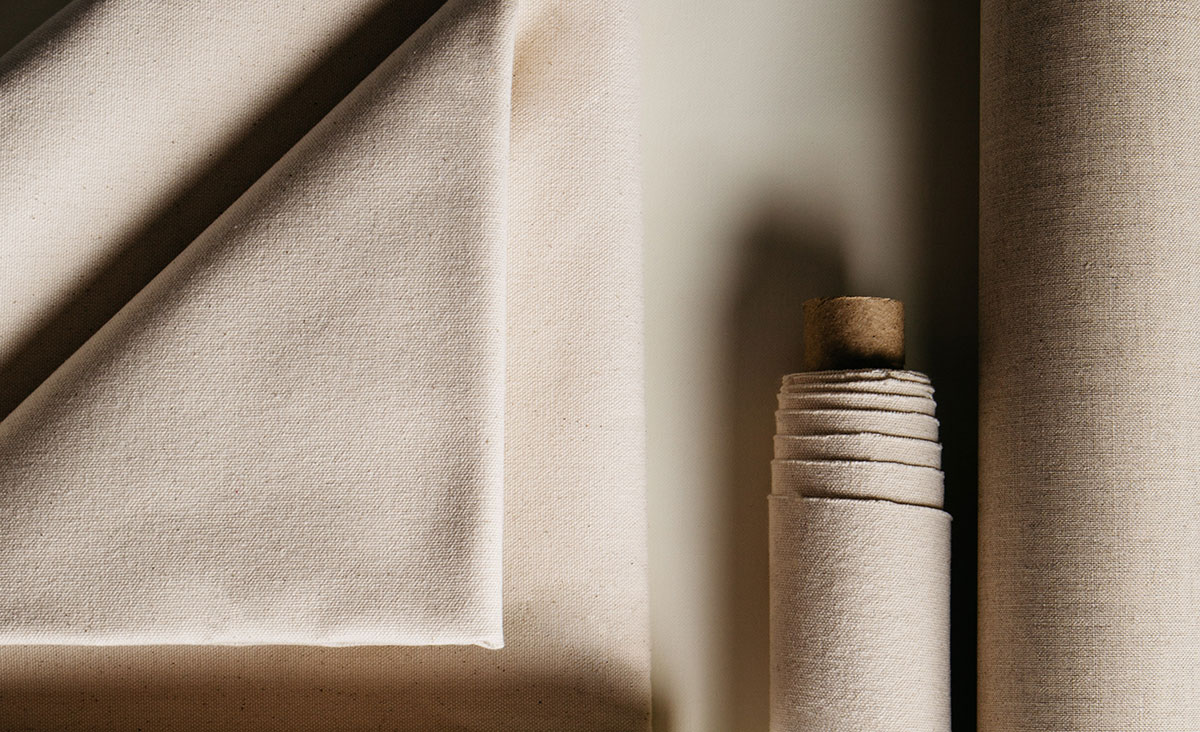
Canvas comes in rolls which are 210 cm or 183 cm wide. A total roll is 10m long. You can purchase the full roll or metres cut off the curl (these must exist whole metres, not fractional). We also offer half-width rolls which are easier to transport and to store in the studio if you are not making very large canvases. Folding primed canvas can scissure the primer so it must ever exist sent and stored on a gyre, even if it is just one metre cut off the coil. But unprimed canvas can exist removed from the ringlet and folded which tin save on aircraft charges as a curlicue is quite long and attracts over-sized aircraft charges.
When measuring to purchase canvas to stretch your ain, be sure to account for the amount required to go up the sides or around to the back of your bars (whichever depth you choose) plus the additional amount you volition demand to grab and pull with your pliers which you will later trim away or fold under. Likewise account for the different widths of some of the rolls of sail.
- Cotton sheet by the metre, 5m or 10m – on a roll or folded (not all canvases are available in all formats)
- Linen canvass past the metre, 5m or 10m – on a roll or folded (not all canvases are available in all formats)
Stretched across confined or mounted on a panel
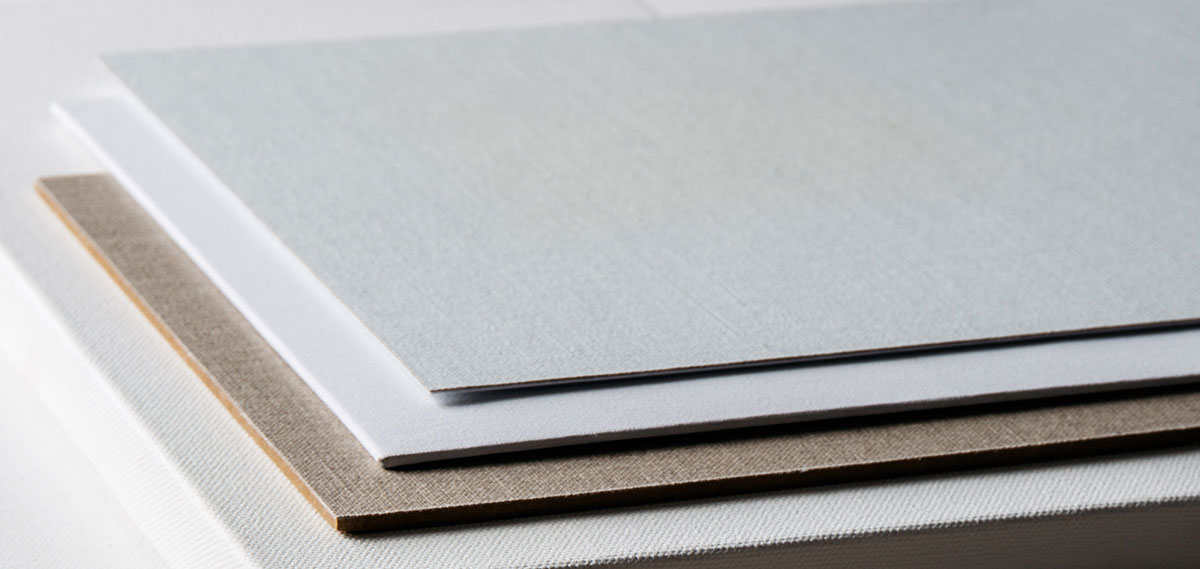
Depending on their painting way some artists like the bounce of a canvas stretched across bars, others prefer the lack of movement of canvas glued to a panel (also called a board). The rigid support tin can be fabricated of solid wood, plywood, MDF, heavy carte du jour, thin stiff plasticised card, or Gatorboard (plastic impregnated foam board). The canvas can be cut off shear with the border of the support or information technology can be wrapped effectually to the back and glued down.
Read more about mounting canvas to a panel in this blog commodity Making a Canvas Painting Panel.
Sizing and Priming with a Ground
The final thing to consider would exist the primer on your canvas. Creating a stable structure before you begin adding paint will help to ensure that the painting will remain in the all-time condition for the longest time. You tin choose from a diverseness of primed surfaces or become with unprimed and treat the surface yourself.
Canvas comes either uncoated or with a primer coating. Jackson'southward stock unprimed, universal primed, oil-primed, gesso-primed and gum-sized sheet past the ringlet and on many of our panels and professional-quality stretched canvases. Not all types of blanket are available on all types of canvas or in all types of format (stretched, panel or by the metre). The priming can be sprayed on in one to seven coats with less expensive educatee-grade canvases being one coat and most artist-grade canvas being two to iv coats. Claessens employ their primer by paw with a palette knife to make sure it is scraped into the weave for the all-time adhesion and protection of the canvas, and then for the oil primed linen they follow upward with a final coat of primer applied with a roller.
You can add together your own boosted blanket on height of a ready-made universal-primed sheet. You may wish to:
- Make the surface more white.
- Colour the surface but keep a gesso texture by adding a tinted ground, a mid-tone coloured ground or a blackness basis.
- Make the surface absorbent enough for watercolour painting by applying a few coats of Watercolour Footing.
- Add together an oil basis for the unique texture that provides.
Sizing
You can pigment on unprimed canvas directly with acrylics but if y'all are painting in oils and you want the painting to final, you lot volition need to seal the surface. Oil pigment dries by oxidation, slowly absorbing oxygen from the air. If canvas or paper is in contact with the oil in oil paint or oil primer it slowly corrodes the canvas fibre. To prevent this canvas needs to be sealed from oil penetration. This sealing process is called 'sizing' and the sealant is called 'size' – so 'to size' your canvass means to seal it. Size is either hibernate glue (rabbit skin glue RSG) or acrylic polymer. The secondary purpose of size is to stiffen the fabric then it has less bounce. RSG comes as pellets that are soaked to soften them and so gently warmed to apply equally a size or role of the recipe of genuine gesso. Warming RSG is not a smelly process, the reputation for smelliness comes from leftover liquid mucilage rotting in a corner of the studio days subsequently. It doesn't rot after it is dried on the canvas. If y'all do determine to use information technology be enlightened that if you do either of these 2 things the mucilage will be less constructive: over-heat it or utilize it afterwards it has rotted from sitting out every bit a liquid for days. Recent studies accept shown that RSG is problematic every bit a size because it continuously absorbs moisture from the air, causing it to cracking and then when the air is dry it shrinks. Over time, this abiding modify in the surface under the brittle layer of oil paint causes the oil paint to crack. RSG is now understood to be the main gene of peachy in old oil paintings. And so for a more than lasting solution many artists now apply a fluid acrylic polymer or a PVA size to seal the canvas and GAC 400 can be used to stiffen the canvas.
A wide range of traditional and modern canvas size (sealant) can be institute at Jackson'south.
Glue-sized canvas
Purchasing canvas that is already gum-sized saves a step when you are stretching canvas and it also makes the linen easier to stretch evenly every bit the added stiffness helps it continue the weave shape.
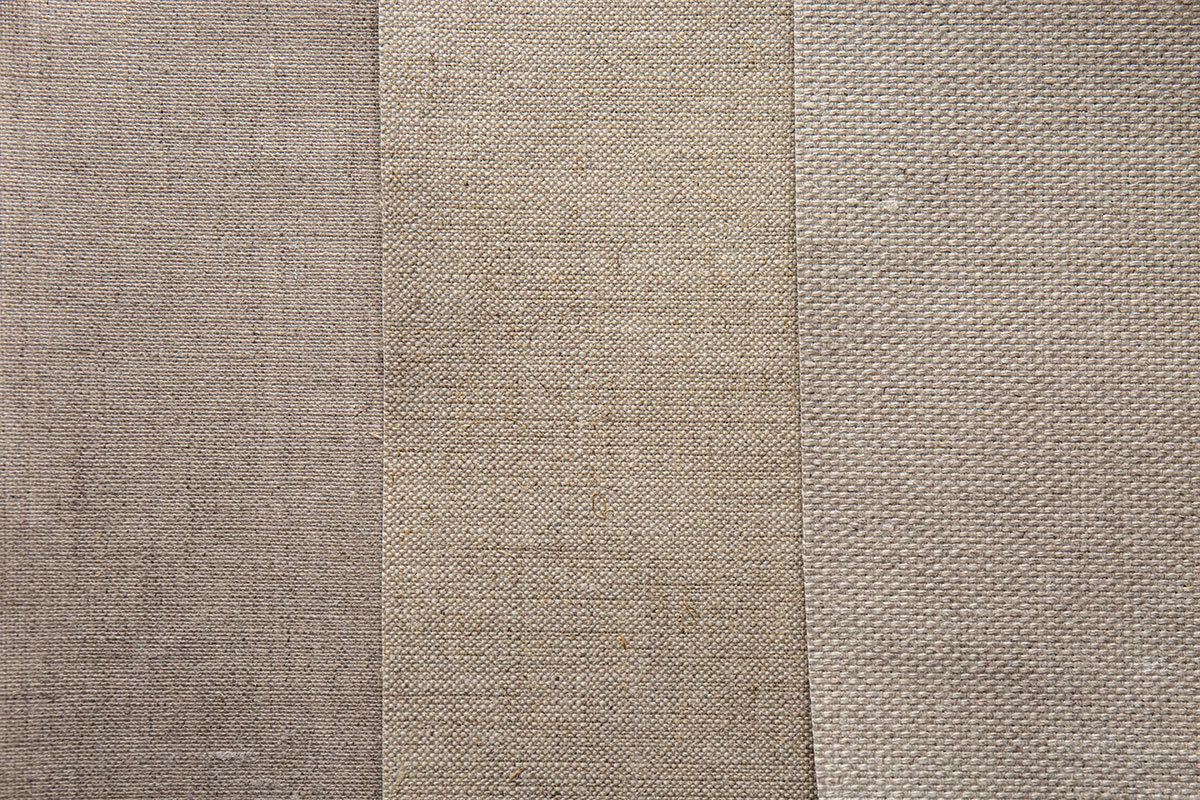
Belle Arti glue sized linen canvas.
From left: extra fine, fine and rough.
Priming
The type of ground affects many things nigh the painting. The amount of tooth affects how well the paint adheres and how much castor-elevate you feel as you pigment. The amount of absorbency affects the glossiness and effulgence of oil color equally the oil is absorbed by the basis and if pigment is also sucked in, the colour will be diminished. An oil basis is often less absorbent and quite polish for a silky painting feel where the colours sit proud and vibrant. After you lot have sized the canvas you tin apply one or more coats of a ground, the surface you lot will apply pigment to that gives the correct amount of tooth, also called providing a 'key' for the pigment to stick to. Priming your own canvas will allow you to really piece of work the first glaze into the weave (to create a good barrier against oil paint penetration) and and so to brand the additional coats every bit smooth or textured equally you wish. Unless y'all sand the dried primer for a really smooth surface, there will probably be some brush mark texture.
Acrylic primer
Acrylic primer usually acts every bit both size and primer. If you are using acrylic primer to provide a barrier to oil pigment cheque if y'all need another coat by holding the canvas upwards to the low-cal – if pin holes of light show through then you demand more primer to seal it. When a canvas says it has Universal Primer that means it is an acrylic primer than tin exist used with acrylic or oil paint. If it is labelled as acrylic 'gesso' this sometimes ways it is more absorbent than acrylic 'primer', though this varies a lot my manufacturer. To apply information technology you usually thin with water for the first coat and scrub it into the weave or scrape it on with a palette knife. So get a flake thicker for each following glaze. Applying primer too thickly may result in cracking when it dries as it volition shrink a lot. So building up the surface with many light coats is better than one heavy ane. A light coat is often dry out enough in 30 minutes to apply the next ane then a batch tin easily exist done in i day. For the smoothest surface many artists sand between coats.
Oil primer
An oil-primed canvas tin simply have oil paints. Although oil paint tin be applied to an acrylic gesso primer, acrylic paint will not permanently adhere to an oil-primed canvas and volition somewhen peel off. Oil primer contains oil paint and so y'all must apply a sizing of some sort first as a bulwark. Information technology commonly need a few weeks to cure as well, so the surface is properly ready to paint on.
Genuine gesso
Genuine gesso is a very absorbent surface, which is what is needed for painting with egg tempera or encaustic. It is made in the studio and applied warm equally it contains RSG. It will crack on flexible surfaces and should be used only on rigid surfaces, usually wooden panels. We now have a 'gesso paw-primed' canvas available in an Italian linen that has quite a delicate dry surface that is very absorbent withal it doesn't hands crack (though it could if handled badly).
Surface texture
Some painters like the wait of the texture of the weave showing through then they do not add many coats of primer, only plenty to seal the canvas and give a white ground. Renaissance masters preferred a super-smooth surface created by applying many coats of primer, sanding between each, until the weave was completely obscured.
Clear primer
Some artists require a clear primer because they wish to use the colour and texture of the canvas equally an integral part of the painting. If you similar the colour of the canvas and don't want a white footing y'all can prime number the canvas with a fluid acrylic medium like Matt Medium or a 'clear acrylic gesso' to soak into the fibres and fill up the weave holes. It ordinarily takes a few coats.
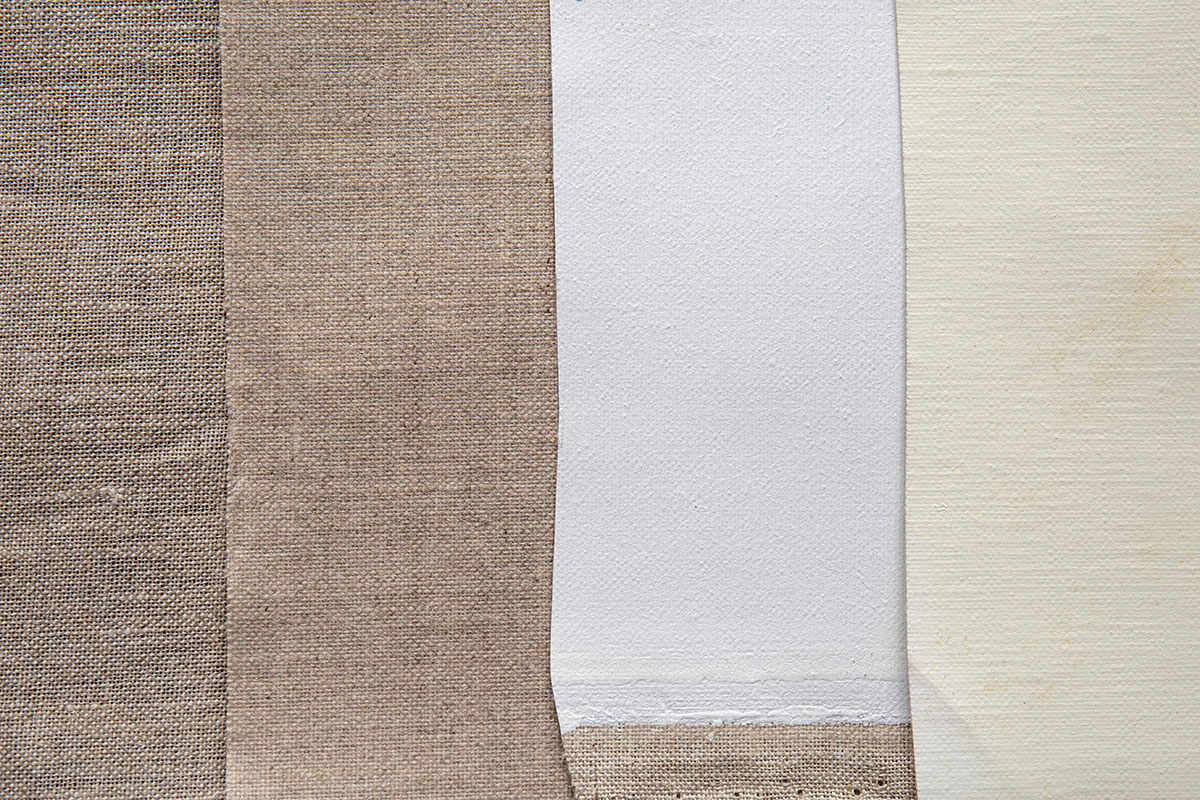
Belle Arti Extra Fine grain linen.
From left: unprimed, gum sized, universal primed, oil primed.
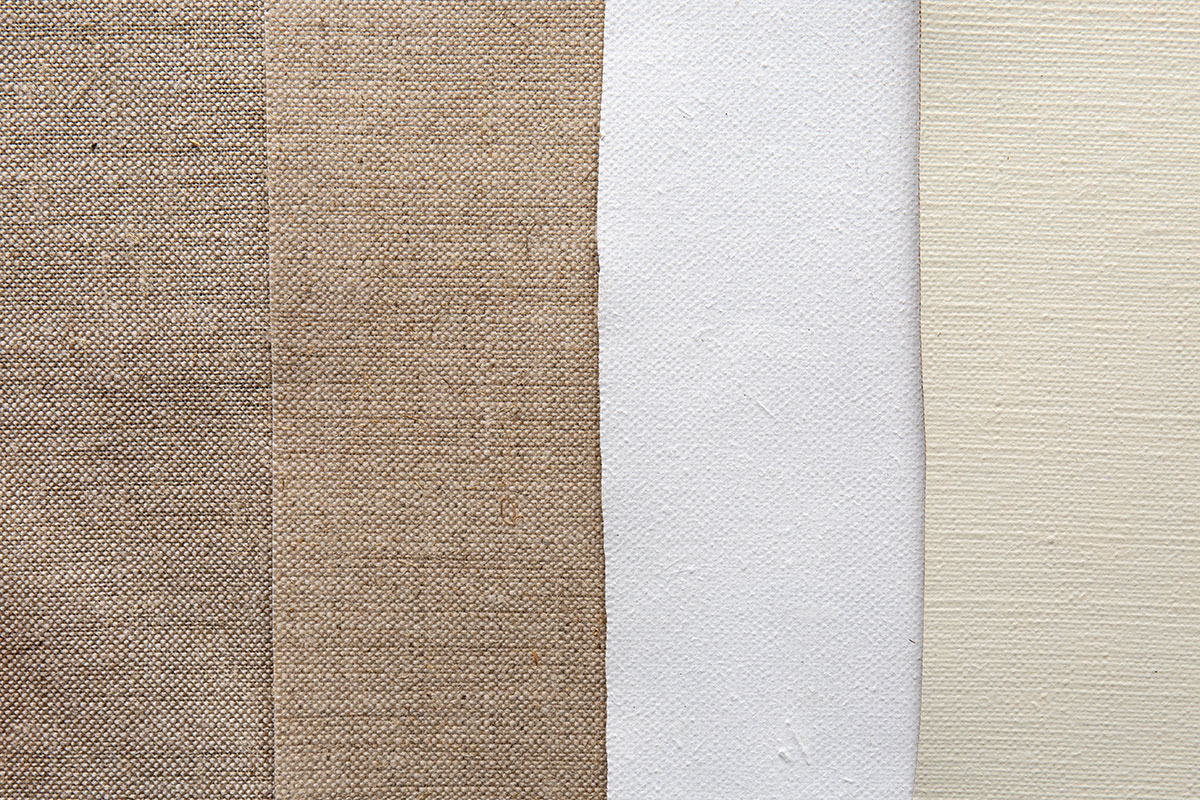
Belle Arti fine grain linen.
From left: unprimed, mucilage sized, universal primed, oil primed.
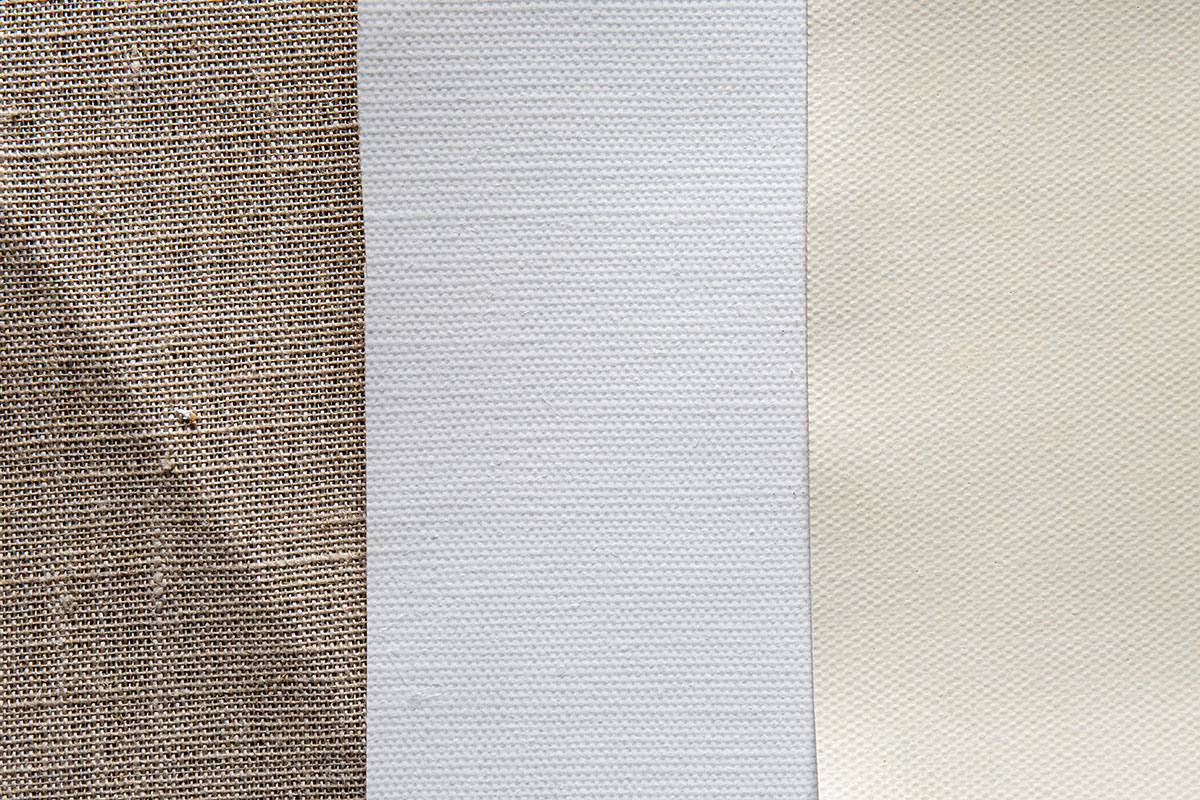
Belle Arti medium grain linen.
From left: unprimed, universal primed, oil primed.
Canvas at Jackson's Fine art
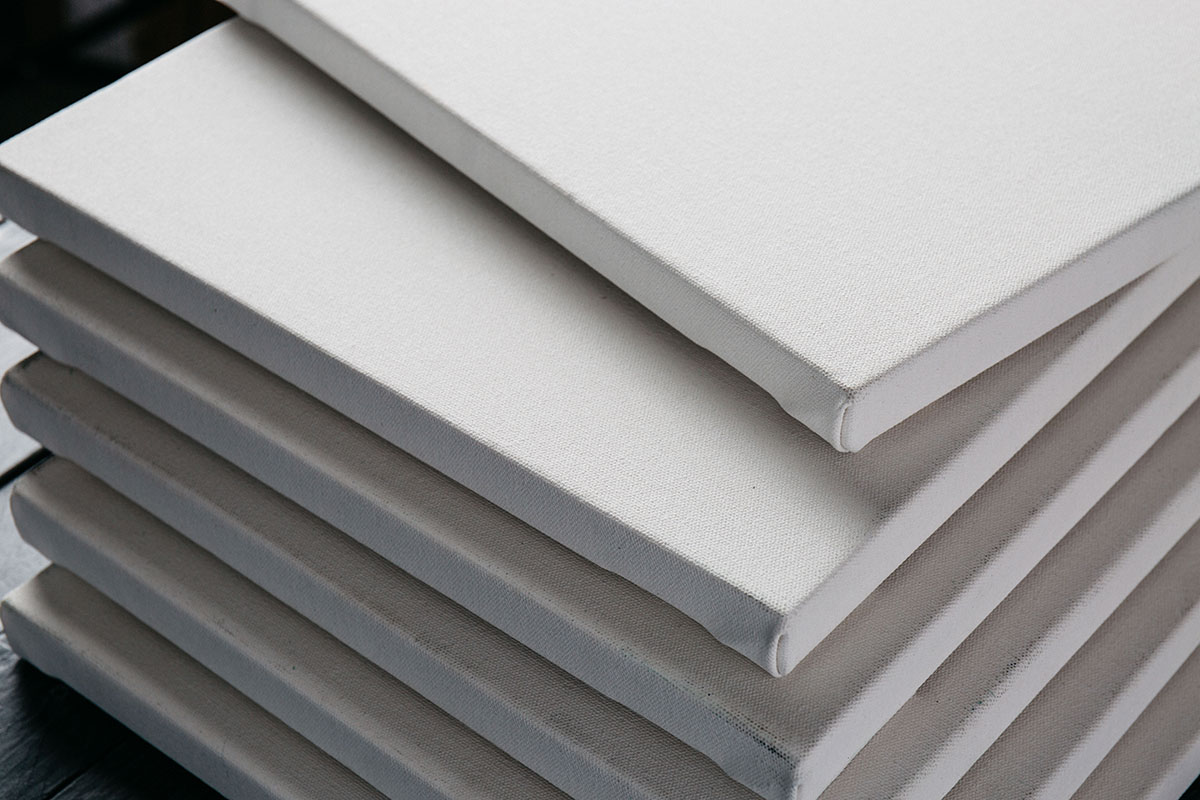
The canvases in this article are available at jacksonsart.com in a variety of formats – ready stretched, mounted on panel and by the metre – set up to be delivered to your studio.
You tin compare some of the canvases that Jackson's stock by ordering sample pieces of the Claessens Linen or the Claessens Linen sample book or the Belle Arti sample book. With the Belle Arti book you get refunded the purchase the price of the book when you lot buy i of the canvases. Since we don't take a way of letting the website know that yous have previously ordered the sample book yous will need to social club the canvas on the telephone and permit the operator know you take purchased the volume.
- Stretched Canvass
- Bespoke Stretched Canvas
- DIY Sail Stretching – Stretcher Bars
- DIY Canvass Stretching – Canvas by the metre
Postage on orders shipped standard to mainland Britain addresses is free for orders of £39.
Source: https://www.jacksonsart.com/blog/2018/09/13/choosing-the-right-canvas-for-your-painting/
0 Response to "Modern Art With Straigh Lines on Canvas With Fabric Colours"
Post a Comment